Level2Expert.com is reader-supported. We may earn a commission when you buy through our links.
The transition is over. As of 2026, the SAE J3400 (NACS) port has officially replaced the old J1772 plug across North America. Whether you’re driving a new Ford, Rivian, GM, or Tesla, you’re now using the same sleek, high-power connector. The «round plug» era is officially in the rearview mirror.
The 2026 Upgrade Rule
If you still own a legacy J1772 vehicle (like an older VW ID.4 or Nissan Ariya), stop buying J1772 chargers. The smart move now is to install a native NACS station and use a simple adapter for your current car. This ensures your home is ready for every new EV hitting the market today.
2026 Market Leaders: Performance Comparison
| Charger Model | Max Output | NACS «Unlock» Button | Price Est. |
|---|---|---|---|
| Tesla Universal Wall Connector | 48A (11.5 kW) | Native | $580 |
| ChargePoint Home Flex (NACS) | 50A (12.0 kW) | Integrated | $549 |
| Emporia Smart EV (NACS) | 48A (11.5 kW) | Integrated | $399 |
1. Tesla Universal Wall Connector: The Dual-Standard Bridge
In 2026, this is the gold standard for mixed-EV households. Tesla’s «Magic Dock» style technology is built right into the handle, allowing you to charge a native NACS car or a legacy J1772 car without ever hunting for a loose adapter.
- Reliability: It’s the most seamless experience on the market. The J1772 adapter is mechanically locked into the station when not in use.
- Power Sharing: You can link up to 6 units on a single circuit, making it the top choice for multi-EV garages.
2. ChargePoint Home Flex: Premium Speed & Build
The Home Flex remains a favorite for its 50A capability (when hardwired on a 70A circuit) and its superior cable quality.
- The «Click» Factor: The NACS handle features a fully functional radio-frequency button to open Tesla charge ports and unlock the connector—no app required.
- Durability: Its cable remains the most flexible in the industry, even in the harshest 2026 winter conditions.
3. Emporia Smart EV Charger: The Data King
If you want to know exactly what your commute costs you in electricity, Emporia NACS is the only way to go. In 2026, it remains the undisputed champion of «bang for your buck.»
- Dynamic Load Management: This is a lifesaver for older homes. If you only have a 100-Amp or 150-Amp panel, Emporia can automatically throttle the charger when your AC or electric oven kicks in, preventing a blown main breaker.
- The Best App in the Business: Second-by-second energy tracking. It doesn’t just charge; it tells you your home’s total energy «health.»
- Price Performance: At roughly $399, you get 48-Amp charging and a high-quality NACS handle with a functional Tesla-port button.
4. Wallbox Pulsar Plus: The Solar Specialist
The Pulsar Plus is remarkably small but packed with intelligence. It’s the top choice for owners who have invested in rooftop solar.
The 800V «Charging Lemon» Problem
The move to NACS (J3400) is great for everyone, right? Not exactly. If you drive a high-voltage beast like the Hyundai Ioniq 5, Kia EV6, or Porsche Taycan, you need to know about the bottleneck.
These cars use an 800V battery architecture designed for ultra-fast charging. However, most older Tesla V3 Superchargers operate at 400V.
The Consequence: When you plug your 800V car into a V3 station, your car has to use its internal «boost converter» to step up the voltage. This often throttles your speed from a massive 230kW down to a measly 50kW–100kW.
The Solution: This isn’t a problem for home charging, but on the road, always look for Tesla V4 Superchargers or NACS-equipped Electrify America stations that support 1,000V.
Adapters: Preventing Charge Port Damage
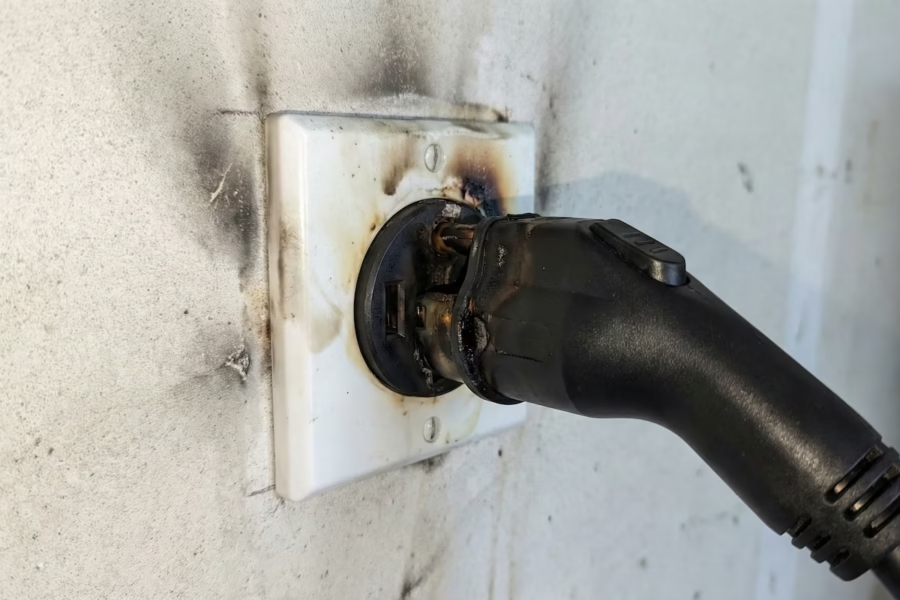
In the 2026 transitional market, adapters are often necessary. However, handling a 48A continuous load requires high-quality components. Cheap, uncertified adapters found on discount sites are a leading cause of melted charge ports and thermal failure.
The Safety Standard: UL 2252
Always verify that any adapter you purchase meets the UL 2252 standard. This certification ensures the device has been tested for thermal management and mechanical durability under high-amperage stress.
Recommended Adapters for 2026
-
A2Z Stellar: Unlike its big brother (the Typhoon Pro for Superchargers), the Stellar is designed specifically for AC home charging. It features the same high-quality metal locking mechanism, ensuring a secure connection for daily 48-Amp charging sessions.
-
Lectron NACS to J1772 Adapter: The standard for converting a NACS wall connector to a J1772 vehicle. Ensure you select the newer models rated for 48 Amps (11.5kW) to match the output of modern home stations.
-
Tesla NACS to J1772 Adapter: The official simple adapter often included with Tesla vehicles. While basic, it is manufactured to the tightest tolerances, ensuring zero play between the handle and the car’s port.
2026 Home Charging Checklist
Before finalizing your home charging setup, ensure it meets the following expert criteria:
- Standard Compliance: Prioritize native NACS (J3400) hardware over legacy J1772 units.
- Installation Method: Hardwiring remains the gold standard for safety and 48A+ speeds.
- Tesla Button Support: Verify the handle includes the radio frequency button for port unlatching.
- Adapter Certification: Only use UL 2252 certified hardware for cross-standard charging.
Conclusion
The standardization of NACS has greatly improved the North American EV experience. By selecting high-quality stations from brands like Emporia, ChargePoint, or Tesla, and adhering to certified safety standards, you are ensuring your home infrastructure is ready for the long term.
NACS & Tesla Charging FAQ
Q: Is a NACS charger the same as a Tesla charger?
Yes. NACS (North American Charging Standard), now codified as SAE J3400, is the technical name for the connector design created by Tesla. Whether you buy a Tesla Wall Connector or a NACS-equipped Emporia/ChargePoint station, the plug is identical and compatible with all Tesla vehicles without an adapter.
Q: Can I use a NACS charger with my older EV that has a J1772 port?
Yes, but you will need a NACS-to-J1772 adapter (often called a «Tesla to J1772» adapter). Many homeowners are now installing NACS chargers to future-proof their homes, using an adapter for their current car and removing it once they upgrade to a newer EV with a native NACS port.
Q: Why is my Hyundai/Kia charging slowly at a Tesla Supercharger?
This is due to voltage mismatch. Most Tesla V3 Superchargers operate at 400V, while cars like the Ioniq 5 or EV6 use an 800V architecture. Your car must «boost» the voltage internally, which limits speeds to 50-100kW. This is a public charging limitation and does not affect your Level 2 home charging speed.
Q: Does the button on third-party NACS chargers work like the Tesla original?
Not always. High-quality stations like ChargePoint Home Flex and Emporia NACS have integrated the UHF radio frequency to open the Tesla charge port door. Cheaper, generic NACS cables or basic adapters often lack this feature, forcing you to open the port via the car’s screen or app.
Q: Are third-party NACS adapters safe for daily use?
Safety depends on certification. Always look for adapters certified to UL 2252 standards. Non-certified adapters are prone to overheating during continuous high-amperage (48A) sessions. For maximum safety, we recommend brands like A2Z or Lectron that have proven thermal management.
Upgrade Your Garage to NACS
Check out our vetted list of the best NACS-native home chargers for 2026.
Fast Shipping via Amazon Prime | Check individual listings for safety certifications